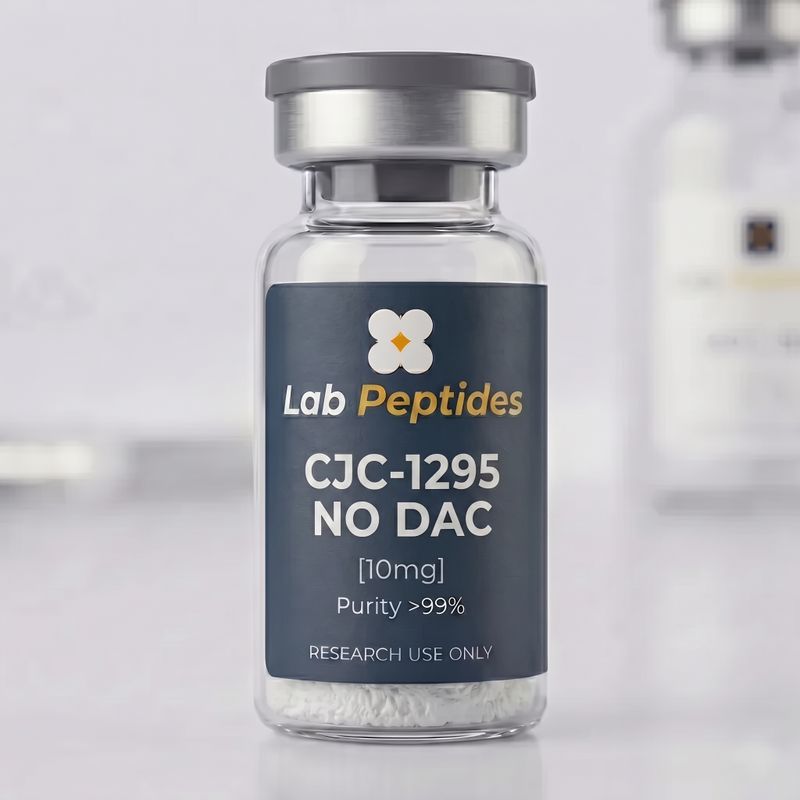
CJC-1295 NO DAC 10mg Croissance musculaire
Le GHRH qui respecte le rythme. Analogue de la GHRH 1-29 modifié sur quatre positions, sans le complexe DAC : il agit sur une trentaine de minutes au lieu de plusieurs jours, et laisse l'hypophyse pulser normalement. Le partenaire de référence de l'Ipamorelin. Pureté HPLC ≥98 %, flacon de 10 mg. Produit destiné à la recherche.
- In stock in France
-10 % for life on each cyclePause, skip or cancel in 1 clickNo commitment, no hidden fees
Your complete kit
- 10mg vialIncluded
- Bacteriostatic waterAdd
- 1 ml syringesAdd
The vial alone cannot be used as is. One sealed vial of CJC-1295 NO DAC 10mg, lyophilised, without individual labelling.
Don't forget the essentials
Frequently bought together




Product information
CJC-1295 without DAC, also known as Mod GRF (1-29), is a synthetic analogue of the first 29 amino acids of human GHRH — the fragment that carries the hormone's activity on its own.
Four substitutions set it apart from the natural sequence: D-Ala2, which protects it from DPP-4 degradation, plus Gln8, Ala15 and Leu27, which improve its stability. The result is a half-life of about thirty minutes, against a few minutes for native GHRH.
The whole difference with CJC-1295 with DAC lies in what is missing: the Drug Affinity Complex, which binds the molecule to albumin and stretches its half-life to several days. Without it, action stays brief — and that is precisely what protocols seeking to preserve the natural pulsatility of growth hormone secretion are after, rather than flattening it.
This vial delivers 10 mg of CJC-1295 without DAC at HPLC purity of at least 98%. For research use only.
01Mechanism of action
GHRH acts on the GHRH-R receptor of somatotroph cells in the anterior pituitary, a G-protein coupled receptor. Its activation raises intracellular cyclic AMP, activates protein kinase A and triggers both the release of stored growth hormone and the transcription of its gene.
The D-Ala2 modification is the decisive one: it blocks the cleavage site of dipeptidyl peptidase-4, the enzyme that inactivates native GHRH within minutes. The other three substitutions limit oxidation and aggregation in solution.
The point that explains the frequent pairing with a GHRP such as Ipamorelin: the two families act on distinct receptors — GHRH-R on one side, GHS-R1a on the other — and through different signalling pathways. The literature describes a response greater than the sum of each taken alone, which is the documented basis for this combination.
By keeping a short action, the DAC-free analogue also lets somatostatin, the axis's physiological brake, express itself, which preserves the pulsatile character of secretion.
Similar peptides
Against CJC-1295 with DAC. Same base peptide, one difference: the affinity complex binding the molecule to albumin. With DAC, half-life extends to several days and elevation becomes continuous — at the cost of pulsatility. Without DAC, action lasts about thirty minutes and lets somatostatin play its braking role. This is not a degraded version, it is a profile choice.
Against Ipamorelin. These are different families, and that is why they are paired: GHRH acts on GHRH-R, Ipamorelin is a GHRP acting on GHS-R1a. Two receptors, two pathways, a combined response described as greater than the sum of both.
Against Tesamorelin. Tesamorelin is also a GHRH analogue, but it is the only one in the class with FDA approval, obtained in 2010 for a specific indication. It is stabilised differently and its documented profile is clinical where CJC-1295 without DAC remains preclinical.
Against IGF-1 LR3. Opposite levels of action: CJC-1295 acts upstream on the pituitary and respects feedback loops, IGF-1 LR3 acts downstream, directly on the IGF-1R receptor.