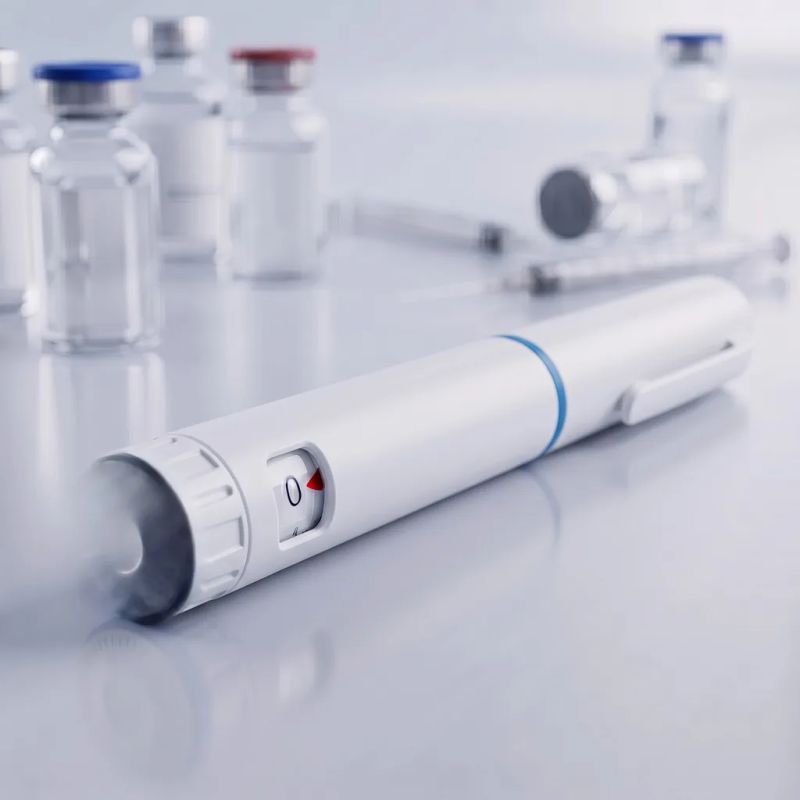
NAD+ Pre-filled Pen 1000mg / 3ml Anti-aging
1000 mg prêts à l'emploi. Personne d'autre ne le fait.
NAD+ in a pre-filled pen, a format almost nobody offers. 1000 mg in 3 ml, sterile solution, dose set on a dial. NAD+ is the central coenzyme of cellular energy metabolism, and it is precisely the molecule whose reconstitution puts people off most: large volumes, awkward powder, approximate dosing. The pen removes all of it. Store between 2 and 8 degrees. For research use.

Longevity
NAD+, MOTS-c, SS-31, DSIP, Sermorelin: the anti-aging arsenal validated by scientific literature.
Explore the rangeProduct information
NAD+ in a pre-filled pen, 1000 mg in 3 ml. The coenzyme supplied as a ready-to-use solution: no powder to dissolve, no volume to calculate, needles included. The dose is set on the dial, in units, and every unit has its milligram equivalent. The simplest format for working with NAD+ without reconstitution equipment.
02Clinical studies
The NAD+ and precursors literature exceeds 15,000 PubMed-indexed publications. Pivotal studies have established three data layers: NAD+ decline with age, precursor efficacy, and human clinical trials.
Massudi 2012 PLoS One first quantified human tissue NAD+ decline: skin biopsies from 30 subjects aged 20-60, mean 50 % drop, negative correlation r = -0.65 with age. Zhu 2015 PNAS showed by in vivo 31P MRS that brain NAD+ falls with age in healthy humans.
Gomes 2013 Cell (Sinclair lab) described the nuclear pseudohypoxia mechanism: the age-related NAD+ drop deactivates SIRT1, which stabilises HIF1alpha, which represses nucleus-encoded mitochondrial transcription, uncoupling mtDNA/nDNA. NMN administration (500 mg/kg IP 7 days) in aged mice restored NAD+ and mitochondrial function to young-mouse levels.
Mills 2016 Cell Metabolism conducted the most comprehensive long-term safety study: oral NMN 100-300 mg/kg/day for 12 months in mice, improved insulin sensitivity, bone density, ocular and muscle function, without detectable toxicity. Yoshino 2021 Science conducted the first human randomised trial: 250 mg/day oral NMN for 10 weeks in 25 prediabetic postmenopausal women, improved muscle insulin sensitivity (hyperinsulinemic clamp, +25 %).
Martens 2018 Nature Communications: randomised crossover trial, 1000 mg/day oral NR for 6 weeks in 30 healthy adults aged 55-79, blood NAD+ elevation of 60 %, systolic blood pressure decrease (-8 mmHg average in mildly hypertensive subjects). Trammell 2016 Nature Communications characterised human NR pharmacokinetics: plasma half-life 2.7 hours, bioavailability superior to nicotinamide, dose-dependent blood NAD+ rise.
Airhart 2017 PLoS One followed 8 heart failure patients on NR 1000 mg/day 9 weeks: blood NAD+ elevation, reduction of NLRP3 activation and pro-inflammatory cytokines. Elhassan 2019 Cell Reports: oral NR 500 mg/day 3 weeks in older men, muscle NAD+ elevation, drop in circulating inflammatory markers (IL-6, TNF-alpha, IL-2).
Regarding subcutaneous injection, human data come mainly from specialised clinics (Springfield Wellness Center, Paterick 2017): 100-500 mg IV or SC protocols in addiction withdrawal programmes, with reports of better mood, sleep and cognitive clarity from non-randomised cohorts. Preclinical studies on direct NAD+ SC injection are limited; most research focuses on oral NR/NMN precursors, whose bioavailability is better documented.
Critical limitation: long-term human trials on precursors remain short (3-12 weeks), cohorts small (<100 subjects), and data on pure NAD+ SC injection essentially observational. Generalisations to global anti-ageing indications are speculative.
- 1
- 2Molécules NADTherapeutic Potential of NAD-Boosting Molecules: The In Vivo Evidence
Rajman L, Chwalek K, Sinclair DA · Cell Metabolism · 2018
- 3Précurseurs NADNAD+ Intermediates: The Biology and Therapeutic Potential of NMN and NR
Yoshino J, Baur JA, Imai SI · Cell Metabolism · 2018
03Research protocols
A pre-filled pen requires no reconstitution. The solution is ready to use: no powder to dissolve, no bacteriostatic water to add, no volume to calculate. That is the essential difference from a vial.
Before first use. Take the pen out of the fridge ten to fifteen minutes beforehand: a cold solution is more uncomfortable to inject, and this is the most common cause of discomfort. Check that the liquid is clear, with no particles. A cloudy appearance or visible particles means it should not be used.
Attaching the needle. Remove the cap, screw on one of the needles supplied with the pen, then remove both needle covers. Use a new needle for every injection, never reuse one.
Priming. Before the very first injection from a new pen, set the dial to the smallest graduation and press the button until a droplet appears at the tip. This clears air from the cartridge and ensures the following dose is complete. It is not repeated for subsequent injections.
Setting the dose and injecting. The dial is set in units, from 1 to 60, never in milligrams. On this 1000 mg pen in 3 ml: 1 unit = 3333.3 mcg; 30 units = 100 mg; 60 units, the maximum, = 200 mg. These figures apply to the 1000 mg pen only. Each unit here is worth more than 3 mg: never reuse the units of another pen. Turn the dial to the desired figure. Pinch the skin lightly, insert the needle at ninety degrees, press the button fully and hold for ten seconds before withdrawing: this ensures the full dose has been delivered. Withdrawing too early is the most common mistake.
Afterwards. Remove the needle, dispose of it in a sharps container, replace the cap and return the pen to the fridge. Rotate the injection site each time.
- The pen carries a handwritten marking: the product initials and the dose. This is our dose marker on the pen body. Check that it matches your order.
- The needles are in the box, not on the pen. Four screw-on needles, a new one for each injection.
- The liquid is clear and colourless, sometimes with a small air bubble. That is expected. Priming, before the first injection, clears the bubble.
- The parcel is plain. Nothing on the outside indicates the contents or the brand name.
What is not normal: cloudy or coloured liquid, visible particles, a cracked pen or a dial that will not turn. In those exact cases, write to us with a photo and we will take the pen back.
04Storage & handling
Store the pen between +2 °C and +8 °C, refrigerated and away from light. This is an important difference from lyophilised powder, which tolerates room temperature: a pen contains an already-reconstituted solution and therefore requires continuous refrigeration.
Never freeze it. A solution that has been frozen and thawed should be discarded, even if it looks normal.
Take the pen out a few minutes before injecting: this noticeably reduces discomfort without breaking the cold chain.
It tolerates a few hours out of the fridge during transport, between the delivery point and home. Return it to the cold as soon as you receive it.
Shelf life when refrigerated: 1 year.