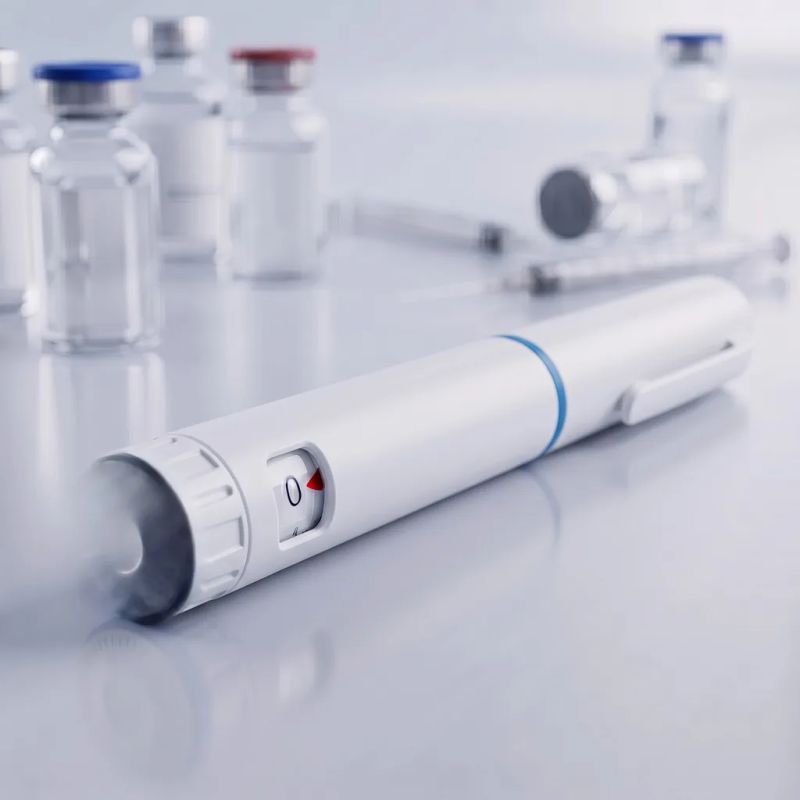
Semaglutide Pre-filled Pen 10mg / 3ml Weight Loss
La molécule la plus documentée, en stylo.
Semaglutide in the form that built its reputation. 10 mg in 3 ml of sterile solution, ready to use, dose set on a dial. No reconstitution, no bacteriostatic water to plan for, no graduation to interpret. It is the most studied GLP-1 agonist of its generation, in the format that makes using it trivial. Store between 2 and 8 degrees. For research use.

Metabolism
Semaglutide, Tirzepatide, Retatrutide: the next-gen GLP-1 redefining weight management research.
Explore the rangeProduct information
Semaglutide in a pre-filled pen, 10 mg in 3 ml. A GLP-1 receptor agonist supplied as a ready-to-use solution: no reconstitution, no volume to calculate, needles included. The dose is set on the dial, in units, and every unit has its milligram equivalent. The most direct format for working with this molecule.
02Clinical studies
Semaglutide's clinical corpus is one of the most extensive of the entire modern peptide class, with more than 30 randomised controlled phase III trials published since 2016 and cumulative pharmacovigilance follow-up exceeding 2 million patient-years.
SUSTAIN program (type 2 diabetes, 8 main trials 2016-2020): evaluation of glycaemic efficacy and weight loss in type 2 diabetics.
- SUSTAIN-1 (Sorli et al 2017, Lancet Diabetes Endocrinol): HbA1c reduction -1.45% vs placebo over 30 weeks at 1mg/week dose.
- SUSTAIN-6 (Marso et al 2016, NEJM): major cardiovascular trial on 3297 high CV risk patients, significant reduction in composite CV mortality / non-fatal MI / non-fatal stroke endpoint (-26%, p=0.02), establishing semaglutide's cardiovascular benefit.
- SUSTAIN-7 (Pratley et al 2018, Lancet Diabetes Endocrinol): head-to-head comparison semaglutide 1mg vs dulaglutide 1.5mg, semaglutide superiority on HbA1c (-1.8% vs -1.4%) and weight (-6.5kg vs -3.0kg).
STEP program (non-diabetic obesity, 8 trials 2021-2023): weight loss evaluation at 2.4mg/week dose (obesity dose, higher than diabetes dose).
- STEP-1 (Wilding et al 2021, NEJM): flagship trial on 1961 non-diabetic overweight or obese adults, mean weight loss of -14.9% at 68 weeks (vs -2.4% placebo), -15% threshold reached in 50.5% of patients. Marking the greatest pharmacological anti-obesity advance since amphetamine derivatives of the 1970s.
- STEP-4 (Rubino et al 2021, JAMA): treatment cessation effect - mean weight regain of +6.9% over 48 post-cessation weeks, confirming the chronic nature required of treatment.
- STEP-5 (Garvey et al 2022, Nat Med): 2-year weight loss maintenance under continuous treatment, no early plateau, total mean loss -15.2%.
SELECT 2023 (Lincoff et al 2023, NEJM): major cardiovascular trial on 17,604 adults with established cardiovascular disease but without diabetes, randomised semaglutide 2.4mg vs placebo, mean 39.8 month follow-up. -20% reduction in primary composite endpoint (CV mortality, MI, stroke, p<0.001), demonstrating for the first time a GLP-1 cardiovascular benefit in secondary prevention in non-diabetics. Opening the way to a dedicated cardiovascular indication, distinct from the metabolic indication.
Detailed pharmacokinetics (Kapitza et al 2015, J Clin Pharmacol; Granhall et al 2019, Clin Pharmacokinet):
- SC bioavailability: 89%
- Tmax: 1-3 days after SC injection
- Distribution volume: 12.5 L
- Plasma protein binding: > 99% (mainly albumin)
- Half-life: 155-180 hours (7-8 days)
- Clearance: 0.05 L/h
- Metabolism: hepatic and renal proteolysis (comparable elimination to native GLP-1 once released from albumin)
- Excretion: 70% urinary, 30% faecal
Tolerance and adverse effects: cumulative SUSTAIN + STEP + SELECT data establish a well-characterised tolerance profile, dominated by digestive effects (nausea 15-44%, vomiting 5-25%, diarrhoea 15-30%, constipation 5-15%), generally transient during titration. Rare but serious effects: acute pancreatitis (< 0.5%), aggravated diabetic retinopathy in poorly controlled patients (SUSTAIN-6 weak signal), theoretical risk of medullary thyroid tumours (rodent signal unconfirmed in humans).
Post-marketing data 2022-2025: emergence of signals on concomitant muscle mass loss (up to 25% of weight loss is lean mass, Heymsfield 2023), persistent gastroparesis post-cessation in a few published cases, and glucagon-mediated peak recovery after abrupt cessation (rebound dumping). These observations reinforce the need for nutritional-muscular support and progressive cessation.
- 1ObésitéOnce-Weekly Semaglutide in Adults with Overweight or Obesity
Wilding JPH, Batterham RL, Calanna S, et al. (STEP 1 Study Group) · New England Journal of Medicine · 2021
- 2CardiovasculaireSemaglutide and Cardiovascular Outcomes in Patients with Type 2 Diabetes
Marso SP, Bain SC, Consoli A, et al. (SUSTAIN-6 Investigators) · New England Journal of Medicine · 2016
- 3Essai cliniqueSemaglutide 2.4 mg once a week in adults with overweight or obesity, and type 2 diabetes (STEP 2)
Davies M, Færch L, Jeppesen OK, et al. (STEP 2 Study Group) · The Lancet · 2021
03Research protocols
A pre-filled pen requires no reconstitution. The solution is ready to use: no powder to dissolve, no bacteriostatic water to add, no volume to calculate. That is the essential difference from a vial.
Before first use. Take the pen out of the fridge ten to fifteen minutes beforehand: a cold solution is more uncomfortable to inject, and this is the most common cause of discomfort. Check that the liquid is clear and colourless. A cloudy appearance or visible particles means it should not be used.
Attaching the needle. Remove the cap, screw on one of the needles supplied with the pen, then remove both needle covers. Use a new needle for every injection, never reuse one.
Priming. Before the very first injection from a new pen, set the dial to the smallest graduation and press the button until a droplet appears at the tip. This clears air from the cartridge and ensures the following dose is complete. It is not repeated for subsequent injections.
Setting the dose and injecting. The dial is set in units, from 1 to 60, never in milligrams. On this 10 mg pen in 3 ml: 1 unit = 33.3 mcg; 30 units = 1 mg; 60 units, the maximum, = 2 mg. These figures apply to the 10 mg pen only: another strength has different ones. Turn the dial to the desired figure. Pinch the skin lightly, insert the needle at ninety degrees, press the button fully and hold for ten seconds before withdrawing: this ensures the full dose has been delivered. Withdrawing too early is the most common mistake.
Afterwards. Remove the needle, dispose of it in a sharps container, replace the cap and return the pen to the fridge. Rotate the injection site each time.
- The pen carries a handwritten marking: the product initials and the dose. This is our dose marker on the pen body. Check that it matches your order.
- The needles are in the box, not on the pen. Four screw-on needles, a new one for each injection.
- The liquid is clear and colourless, sometimes with a small air bubble. That is expected. Priming, before the first injection, clears the bubble.
- The parcel is plain. Nothing on the outside indicates the contents or the brand name.
What is not normal: cloudy or coloured liquid, visible particles, a cracked pen or a dial that will not turn. In those exact cases, write to us with a photo and we will take the pen back.
04Storage & handling
Store the pen between +2 °C and +8 °C, refrigerated and away from light. This is an important difference from lyophilised powder, which tolerates room temperature: a pen contains an already-reconstituted solution and therefore requires continuous refrigeration.
Never freeze it. A solution that has been frozen and thawed should be discarded, even if it looks normal.
Take the pen out a few minutes before injecting: this noticeably reduces discomfort without breaking the cold chain.
It tolerates a few hours out of the fridge during transport, between the delivery point and home. Return it to the cold as soon as you receive it.
Shelf life when refrigerated: 1 year.