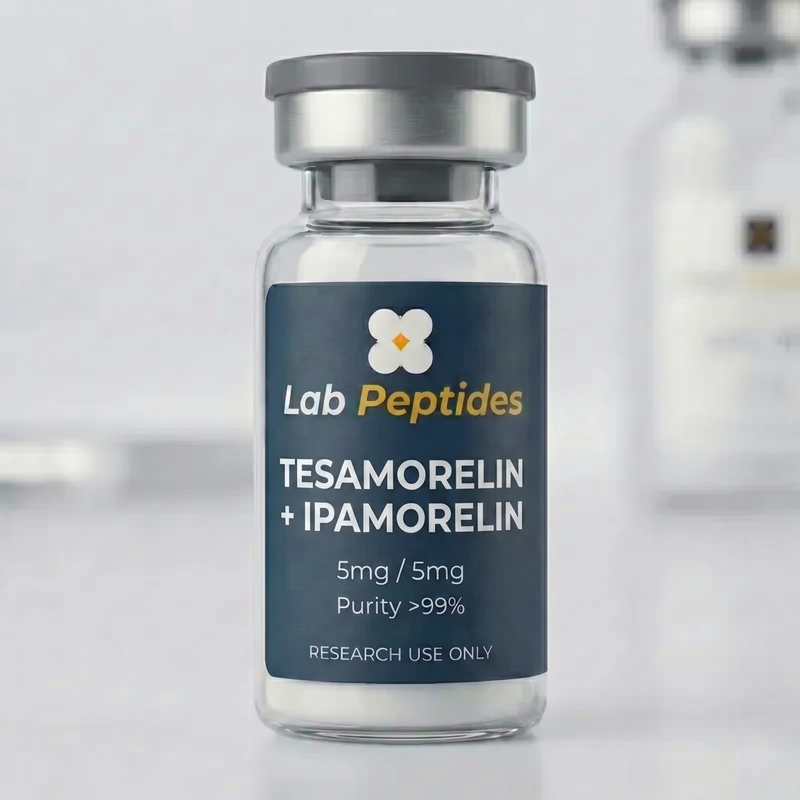
Tesamorelin + Ipamorelin 8mg Muscle Growth
GHRH analog + ghrelin mimetic combo. Two complementary mechanisms of somatotropic axis activation in a single formulation.
The ultimate growth combo. GHRH (Tesamorelin) + ghrelin mimetic (Ipamorelin) in synergy — dual GH-axis stimulation via independent pathways. Multiplied IGF-1, boosted recovery, transformed body composition. The pro formula.

Product information
The Tesamorelin + Ipamorelin 8mg combo brings together in a single lyophilized vial the two best-characterized growth hormone secretagogues in the peptide pharmacopoeia: 5 mg of Tesamorelin (stabilized analogue of human GHRH(1-44) developed by Theratechnologies, FDA-approved in November 2010 under the trade name Egrifta for HIV-associated lipodystrophy) paired with 3 mg of Ipamorelin (Aib-His-D-2-Nal-D-Phe-Lys-NH2 pentapeptide secretagogue designed by Novo Nordisk in 1998, selective ghrelin receptor GHSR-1a agonist). Together these molecules reconstruct the neuroendocrine architecture of the hypothalamic double relay orchestrating physiological growth hormone pulsatility: GHRH to initiate somatotrope transcription, GHRP to release pituitary stores.
This two-tier architecture, formalized by Cyril Y. Bowers' foundational work (1991 Endocrinology) on GHRH + GHRP synergy, produces a GH pulse amplified 3 to 5 fold compared to isolated administration of either peptide, while preserving physiological pulsatility of secretion. Unlike exogenous recombinant growth hormone administration — which imposes a continuous supraphysiological level and drives negative feedback on the endogenous somatotrope axis — the secretagogue combo respects the IGF-1 / somatostatin feedback loop: the hypothalamus retains command, the pituitary delivers its load.
Tesamorelin specifically contributes the visceral-abdominal lipolytic effect validated in a phase III clinical trial (Falutz NEJM 2007; Falutz JCEM 2010; Stanley JAMA 2011), unique among available GH secretagogues: 15 to 20% reduction in visceral adipose tissue (VAT) measured by MRI over 26 weeks, without equivalent subcutaneous tissue loss. Ipamorelin contributes the purest available ghrelinergic selectivity: no cortisol elevation, no prolactin rise, marginal appetite effect — in contrast to first-generation GHRPs (GHRP-2, GHRP-6, hexarelin) that carried documented collateral hormonal effects.
Reserved exclusively for RUO preclinical research: no human application outside Egrifta in its official indication (HIV lipodystrophy).
01Mechanism of action
Tesamorelin — GHRH(1-44) stabilized by N-terminal modification
Tesamorelin is a copy of endogenous human 44-residue GHRH, modified by conjugation of the N-terminal residue with a trans-3-hexenoyl group. This modification protects the peptide from dipeptidyl peptidase IV (DPP-IV) cleavage, which limits native GHRH plasma half-life to approximately 7 minutes. Tesamorelin achieves a plasma half-life of approximately 8 minutes via SC route per the FDA Egrifta SV label — the actual advantage over native GHRH (~7 min) lies in DPP-IV cleavage resistance and storage stability, enabling once-daily subcutaneous administration.
Mechanism of action: Tesamorelin binds the GHRH receptor (GHRH-R) specifically expressed on somatotropes of the anterior pituitary. Receptor activation triggers:
1. Coupling to Gs alpha-stimulatory protein;
2. Adenylate cyclase activation, intracellular cAMP rise;
3. PKA activation, CREB phosphorylation;
4. GH gene transcription and new growth hormone synthesis;
5. Exocytosis of storage granules via Ca2+ / calmodulin pathway.
The major physiological effect documented clinically is visceral adipose tissue reduction: GH released by GHRH stimulation preferentially activates hormone-sensitive lipase (HSL) in visceral adipocytes (richly expressing GH receptors), driving lipolysis specific to this compartment. Phase III trials (Falutz 2007 NEJM, Falutz 2010 JCEM, Stanley 2011 JAMA) demonstrated 15 to 20% VAT reduction measured by abdominal MRI over 26 weeks, with concurrent lipid profile restoration (triglyceride decrease, HDL increase), without equivalent subcutaneous adipose loss.
Ipamorelin — Selective ghrelinergic pentapeptide
Ipamorelin is a synthetic pentapeptide of sequence Aib-His-D-2-Nal-D-Phe-Lys-NH2 (711.85 Da) developed at Novo Nordisk in the 1990s. It acts as a selective ghrelin receptor agonist (GHSR-1a) expressed on somatotropes of the anterior pituitary and in the hypothalamus. Foundational publication: Raun et al. (Eur J Endocrinol 1998, 139:5).
Mechanism of action:
1. GHSR-1a binding, coupled to Gq protein;
2. Phospholipase C activation, IP3 and diacylglycerol generation;
3. Intracellular calcium mobilization from endoplasmic reticulum;
4. Rapid exocytosis of already-synthesized GH storage granules.
Remarkable selectivity: unlike first-generation GHRPs (GHRP-2, GHRP-6, hexarelin) that secondarily stimulate prolactin, ACTH and cortisol release via extra-pituitary ghrelinergic pathways, Ipamorelin behaves as a functionally biased agonist: pure GH release, no cortisol or prolactin elevation at pharmacological doses (Raun 1998; Andersen 2001). The orexigenic effect characteristic of native ghrelin and historical GHRPs remains marginal: no pronounced appetite increase at standard secretagogue doses.
GHRH + GHRP synergy — Double relay architecture
The GHRH + GHRP combination is the most powerful known secretagogue strategy, formalized by Cyril Y. Bowers (Endocrinology 1991; Horm Res 1993; JCEM 1996). Three mechanisms explain the synergy:
1. Signaling pathway complementarity — GHRH activates the cAMP/PKA pathway (transcription), Ipamorelin activates the Ca2+/PKC pathway (exocytosis). Both signals converge on the somatotrope with additive or supra-additive effects.
2. Reciprocal somatostatin inhibition — GHRPs (ghrelin-mimetics) attenuate hypothalamic somatostatin inhibitory tone that normally dampens the GHRH response. Result: GHRH response in the presence of GHRP is amplified 3 to 5 fold relative to the same isolated GHRH dose.
3. Recruitment of distinct cell populations — Some data suggest GHRH and GHRPs recruit partially different somatotrope subpopulations, expanding the mobilized cell pool.
Physiological pulsatility (dominant nocturnal GH peaks, smaller daytime peaks) is preserved with the secretagogue combo — a major advantage over exogenous recombinant GH which saturates the receptor continuously and induces progressive tachyphylaxis.
Similar peptides
Combo versus Tesamorelin alone (Egrifta)
Tesamorelin alone at the label dose (2 mg/day SC) is the clinically validated option for HIV lipodystrophy. The combo adds the ghrelinergic pulsatility dimension of Ipamorelin, exploits the GHRH + GHRP synergy documented by Bowers, and enables dose fractionation (morning + evening) that is not relevant with Tesamorelin alone (short half-life but GH effect not limited by the isolated GHRH receptor).
Combo versus Ipamorelin alone (5mg)
Ipamorelin alone is excellent as a selective secretagogue without collateral hormonal effects, but its GH response is capped by hypothalamic somatostatinergic tone which is not attenuated in the absence of GHRH input. Adding Tesamorelin releases the somatotrope cell from the deficient GHRH brake + potentiates the Ipamorelin response via pathway synergy. The combo is therefore structurally superior to Ipamorelin alone for GH response magnitude.
Combo versus CJC-1295 + Ipamorelin (classical stack)
CJC-1295 (with or without DAC) is another GHRH analogue with extended half-life (about 8 days with DAC via albumin conjugation). Tesamorelin vs CJC-1295 comparison:
- Tesamorelin — 30 min half-life, fine mimicry of physiological pulsatility, FDA approved, robust human data, VAT effect specifically documented by MRI.
- CJC-1295-DAC — 8-day half-life, continuous IGF-1 elevation (closer to "GH substitution" than physiological pulsatility), no FDA approval, no comparable published human data.
The Tesamorelin + Ipamorelin combo is therefore more physiological and better documented, but less practical (daily injections vs 2x/week for CJC-1295-DAC).
Combo versus MK-677 (ibutamoren)
MK-677 is a oral non-peptidic GH secretagogue (small-molecule GHSR agonist), 24h half-life, one dose/day. Major advantage: oral route, absolute simplicity. Drawbacks: marked appetite increase (full ghrelin effect, unlike Ipamorelin), significant water retention, debated cortisol elevation, continuous (non-pulsatile) IGF-1 effect. The Tesamorelin + Ipamorelin combo is preferred for protocols specifically oriented toward VAT reduction (Tesa effect) and preservation of physiological pulsatility (selective Ipa).
Combo versus exogenous Growth Hormone (somatropin)
Recombinant GH (Saizen, Genotropin, Humatrope) is the direct hormone-replacement option. Advantages: immediate and powerful effect, predictable and titratable IGF-1 levels, multiple labeled indications (adult GHD, cachexia, etc.). Major drawbacks: negative feedback on the endogenous somatotrope axis (endogenous GH suppression).loss of physiological pulsatility (continuous supraphysiological level).considerably higher cost.documented adverse effects (edema, carpal tunnel syndrome, glucose intolerance, arthralgias). The Tesamorelin + Ipamorelin combo positions itself as an orthogonal strategy preserving the endogenous axis.