Cagrilintide (AM-833): complete guide to the long-acting amylin analog in metabolic research
Cagrilintide (Novo Nordisk development code AM-833 / NN9838) is a long-acting synthetic analog of amylin, the second major pancreatic hormone co-secreted with insulin by beta cells. Designed to overcome the two fundamental weaknesses of native amylin — amyloid fibril aggregation and a 13-minute plasma half-life — cagrilintide combines three anti-aggregation proline substitutions with a C20 lipid chain enabling once-weekly subcutaneous dosing. Paired with semaglutide in the fixed-combination CagriSema, it is now one of the most advanced candidates in the anti-obesity peptide class, with a mechanism complementary to GLP-1 / GIP / glucagon agonists.
This guide consolidates all publicly available data through late 2025 on cagrilintide's molecular structure, its mechanism at the amylin receptor complex (CTR + RAMP1/2/3), its pharmacokinetics, the REDEFINE clinical program, comparisons with pramlintide (Symlin, first generation), synergy with semaglutide and retatrutide, and reconstitution protocols for research. All references are intended for research use only (RUO), in vitro and in vivo, in accordance with applicable requirements in France and Europe.
Molecular identity and pharmacochemistry
Cagrilintide is a synthetic peptide of 37 amino acids built on the human amylin sequence (hIAPP, human islet amyloid polypeptide) but engineered to neutralize its amyloid aggregation tendency and extend its half-life. Its development code is AM-833 (or NN9838 in Novo Nordisk nomenclature), its monoisotopic molecular mass approximately 4342 Da, and its structure features an intramolecular Cys2-Cys7 disulfide bond characteristic of the calcitonin-amylin-CGRP family.
Three key pharmacochemical modifications distinguish cagrilintide from native amylin. First, three proline substitutions at positions 25, 28 and 29 (Pro25, Pro28, Pro29) — directly inspired by pramlintide — disrupt the beta-sheets responsible for amyloid fibril formation and fully eliminate the pancreatic toxicity associated with pure amylin. Second, a C20 diacid fatty acid chain grafted through a gamma-glutamate spacer onto lysine 8 enables reversible binding to human serum albumin (HSA). Third, several other amino-acid substitutions optimize helix stability and receptor selectivity.
Cagrilintide's design is described in foundational publications by Nascimento et al. (Journal of Endocrinology, 2019) and Lau et al. (Molecules, 2020), who characterized sub-nanomolar affinity in vitro at the three amylin receptor subtypes and demonstrated plasma stability supporting weekly dosing.
Mechanism of action: amylin receptor and signaling
Amylin and cagrilintide do not have a dedicated receptor. They act on a heteromeric complex formed by the calcitonin receptor (CTR) associated with one of three RAMP proteins (Receptor Activity-Modifying Protein): RAMP1, RAMP2 or RAMP3. These three associations constitute the amylin receptors AMY1-R, AMY2-R and AMY3-R respectively. The primary brain target region is the area postrema, a circumventricular organ lacking blood-brain barrier that provides direct access to circulating signals.
Cagrilintide binding to the CTR-RAMP complex primarily activates Gs protein (cAMP increase via adenylate cyclase) and, to a lesser extent, Gq protein (phospholipase C activation, IP3 generation and intracellular calcium mobilization). This dual signaling triggers several concurrent and synergistic physiological effects: gastric emptying slowdown, postprandial glucagon suppression, satiety induction via area postrema and brainstem neurons, and reduced food intake.
Unlike GLP-1 agonists, amylin does not directly stimulate insulin secretion from beta cells, and unlike glucagon, it does not stimulate thermogenesis. Its signature is purely anorexigenic and glucagonostatic, making it a complementary and non-redundant mechanistic partner to GLP-1 agonists.
Pharmacokinetics and ADME
Cagrilintide's C20 lipid chain supports a plasma half-life of approximately 159 hours (6-7 days) in humans, compatible with once-weekly subcutaneous dosing. After subcutaneous injection, peak plasma concentration (Cmax) is reached at 24 to 72 hours. Absolute subcutaneous bioavailability is estimated above 80%.
Cagrilintide binds more than 99% to serum albumin, which protects the molecule from glomerular filtration and the rapid proteolysis affecting native amylin. Clearance is via general peptide catabolism (non-specific plasma and tissue enzymes) without significant cytochrome P450 involvement, minimizing drug-drug interaction risk. Volume of distribution is low (close to plasma volume), consistent with an albumin-bound peptide profile.
A notable cagrilintide feature is the absence of DPP-4 fragmentation: unlike GLP-1 and GIP agonists, amylin is not a dipeptidyl peptidase-4 substrate, which simplifies pharmacokinetic design and reduces potential gliptin interactions.
REDEFINE clinical program and CagriSema
Cagrilintide is developed by Novo Nordisk along two axes: monotherapy and fixed combination with semaglutide (CagriSema).
Enebo et al. (Lancet, 2021) published the phase 1b trial evaluating cagrilintide monotherapy over 12 weeks. At the 4.5 mg weekly dose, average weight loss reached -10.8% (vs -3.0% placebo), demonstrating substantial single-molecule efficacy. This publication grounded subsequent clinical development.
CagriSema is the fixed combination of cagrilintide 2.4 mg + semaglutide 2.4 mg in a single weekly injection. This combination leverages the mechanistic complementarity: semaglutide provides GLP-1 insulinotropic stimulation and hypothalamic satiety; cagrilintide adds gastric emptying delay, postprandial glucagon suppression and an additional satiety pathway via area postrema.
The phase III REDEFINE program includes multiple parallel trials. REDEFINE-1 (NCT05567796) evaluates CagriSema in adults with obesity over 68 weeks. REDEFINE-2 (NCT05394519) targets adults with obesity and type 2 diabetes. REDEFINE-3 addresses long-term cardiovascular safety through MACE endpoints. Public interim results indicate weight loss on the order of -20 to -23% at 68 weeks under CagriSema, positioning the combination at the tirzepatide level and just below retatrutide.
A parallel REIMAGINE program explores additional indications and flexible dosing. The REIMAGINE design allows independent individual titration of cagrilintide and semaglutide, flexibility absent from the fixed CagriSema combination.
Comparison versus pramlintide (Symlin)
Pramlintide (Symlin, AstraZeneca / AmyLine) is the first-generation amylin analog, FDA-approved in 2005 for adjunct administration with insulin in type 1 and type 2 diabetes. It shares the three anti-aggregation proline substitutions (Pro25/28/29) but lacks a lipid chain, limiting its half-life to approximately 48 minutes and requiring three-times-daily subcutaneous injection at mealtimes.
Cagrilintide radically transforms this pharmacokinetic profile: same peptide backbone (with a few substitutions), same receptor profile, but C20 acylation multiplying half-life by a factor of 200 (48 minutes vs 159 hours). This evolution is strictly analogous to the exenatide -> semaglutide or liraglutide -> semaglutide leap: same mechanism, same class, pharmacokinetics transformed by acylation chemistry.
Clinical consequence: pramlintide is a niche insulin adjuvant; cagrilintide becomes an autonomous or combined weekly metabolic pillar.
Synergy with GLP-1, GIP and GCGR
Cagrilintide + GLP-1 agonist combinations leverage a principle of hormonal complementarity. Physiologically, amylin and GLP-1 are secreted in distinct timing and compartments: amylin is co-secreted with insulin by the pancreatic beta cell immediately after the meal; GLP-1 is released by intestinal L-cells in response to luminal nutrients. Both hormones converge on partially distinct central satiety pathways (area postrema for amylin, arcuate nucleus for GLP-1).
This complementarity translates into additive, even slightly supra-additive efficacy demonstrated in CagriSema trials. The logical perspective is a cagrilintide + retatrutide combination, which would combine four complementary mechanisms (GLP-1R, GIP-R, GCGR, AMY-R) in a single weekly injection. Preliminary preclinical work in rodents suggests full additivity on weight loss without compromising glycemic control.
Biomarkers and scientific readout
Reading cagrilintide data relies on several key biomarkers: body weight (primary endpoint), fasting and postprandial glucagon (signature of the glucagonostatic effect), gastric emptying measured by scintigraphy or paracetamol test, HbA1c (overall glycemia), body composition by DEXA, blood pressure and lipid panels. Subjective satiety parameters (VAS scales) and ad libitum food intake (test meal) are finer markers of the specific amylin mechanism.
For exploratory research, immunohistochemistry of area postrema neurons (c-Fos after acute stimulation) and measurement of CTR-RAMP receptor internalization in cell culture are the mechanistic signature tools.
Reconstitution protocols (research use only)
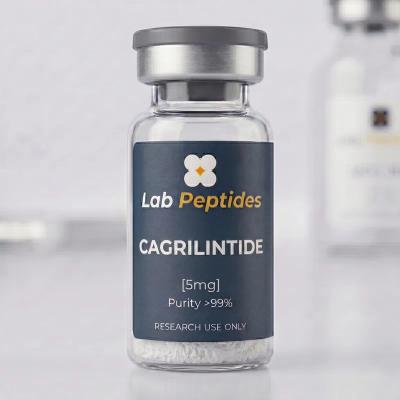
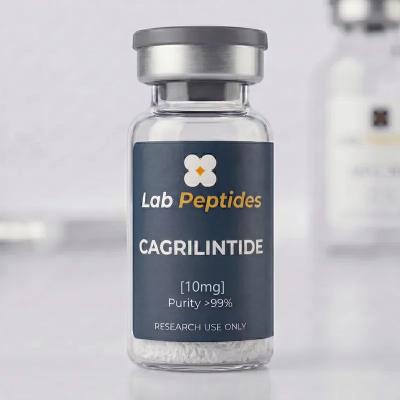
Lyophilized cagrilintide is typically reconstituted with bacteriostatic water (0.9% benzyl alcohol) to yield a stable solution. For a 10 mg vial, standard reconstitution in 1 ml of bacteriostatic water gives a 10 mg/ml concentration (i.e. 0.024 ml = 240 µg = weekly CagriSema-equivalent dose). Volume flexibility allows adjusting concentration to 5 mg/ml (2 ml) or 2.5 mg/ml (4 ml) depending on the experimental design.
The 5 mg and 20 mg vials follow the same dilution logic. Critical research parameters: reconstitution temperature (ideally 2-8 °C), slow injection against the vial wall to avoid shear denaturation, gentle swirling (no aggressive vortex), and complete homogenization before sampling.
Stability, storage and interferences
In lyophilized state, cagrilintide stores for several years at -20 °C protected from light and moisture. Once reconstituted in bacteriostatic water, documented stability is 28 days at 2-8 °C for peptides of this class, subject to aseptic handling. Unlike native amylin (prone to amyloid aggregation in solution), cagrilintide — thanks to the Pro25/28/29 substitutions — remains in solution without fibril formation, even at high concentration.
Major degradation pathways to monitor are methionine and tryptophan oxidation, glutamine deamidation, and peptide bond hydrolysis in acidic or basic media. The Cys2-Cys7 disulfide bond must be protected from reducing agents (DTT, beta-mercaptoethanol).
Clinical and regulatory outlook
FDA filing for CagriSema in obesity is expected in 2026 after full readout of REDEFINE-1 and REDEFINE-2. The EMA will follow. Cagrilintide monotherapy could also obtain an independent indication in certain populations (obesity with GLP-1 contraindication). Exploratory indications include type 1 diabetes (extending pramlintide's positioning) and some forms of poorly controlled insulin-requiring diabetes.
CagriSema's market entry will position Novo Nordisk against Lilly's tirzepatide (Zepbound / Mounjaro) and anticipate retatrutide's arrival. The obesity market, estimated at USD 100 billion by 2030, will be segmented among mono-agonists (semaglutide), co-agonists (tirzepatide), triagonists (retatrutide) and amylin + incretin combinations (CagriSema).
Origins and pharmacological heritage
Amylin was identified in 1987 by two independent teams: Westermark et al. in Uppsala (Sweden) and Cooper et al. in Oxford (UK, publication in The Lancet). Both extracted the peptide from islets of Langerhans in patients with type 2 diabetes, where it forms pathognomonic amyloid deposits. The discovery of amylin-insulin co-secretion by the beta cell opened a new research field on the integrated metabolic role of islet-hormone secretions.
Pramlintide (Symlin), developed by Amylin Pharmaceuticals and approved in 2005, provided the first clinical proof of concept but never achieved significant commercial success due to the three-daily-injection constraint. Cagrilintide, by solving this constraint through acylation, revives the amylin class in a commercially and clinically viable form. Novo Nordisk, through its integrated peptide expertise (semaglutide, cagrilintide, amycretin), positions itself as the integrated leader of the incretin-amylin class.
Deeper intracellular signaling
The CTR-RAMP complex constituting the amylin receptor shows biased signaling depending on the RAMP partner. CTR-RAMP1 (AMY1-R) preferentially couples Gs and Gq in a balanced ratio. CTR-RAMP3 (AMY3-R) favors pure Gs with prolonged cAMP activation. This functional diversity explains the variety of amylin's physiological effects and offers a design lane for more selective future molecules.
CTR receptor desensitization is mediated by GRKs (G protein-coupled receptor kinases) and beta-arrestin, with internalization followed by recycling or lysosomal degradation. Cagrilintide exhibits a modulated functional bias that limits rapid desensitization and partly explains its ability to sustain chronic stimulation without pharmacological escape, a potential advantage over pramlintide.
Cardiovascular safety and signals to monitor
Unlike GLP-1 agonists, cagrilintide does not significantly increase heart rate. Cardiovascular effects to monitor are mainly indirect (weight loss -> blood pressure reduction, lipid profile improvement). REDEFINE-3 MACE endpoints will provide the pivotal data on major cardiovascular events.
The most frequent side effects are digestive (nausea, vomiting, diarrhea), comparable in intensity to GLP-1 agonists. Gradual titration over 12 to 16 weeks substantially reduces their incidence. Specific amylin monitoring includes fasting glycemia (avoid hypoglycemia in insulin-requiring diabetics), thyroid function (amylin / CTR class signal) and digestive markers.
Positioning in the peptide research ecosystem
Cagrilintide is the complementary building block to GLP-1 / GIP / GCGR agonists. Exploratory combinations at preclinical or clinical stages include: cagrilintide + semaglutide (CagriSema, phase III), cagrilintide + tirzepatide (exploratory), cagrilintide + retatrutide (quadruple agonist horizon), and amycretin (Novo Nordisk NN1213), a single peptide molecule natively combining GLP-1 and amylin activities.
On the basic research side, cagrilintide serves as a pharmacological probe to explore CTR-RAMP receptor biology and will fuel a new generation of amylin analogs selective for the AMY1/2/3-R subtypes, potentially able to dissociate satietogenic from glucagonostatic effects.
Conclusion
Cagrilintide represents the pharmacological renaissance of the amylin class. Anti-amyloid proline substitutions, C20 acylation, weekly half-life: every parameter has been engineered to turn a historical pancreatic peptide into a flagship metabolic therapeutic. Combined with semaglutide in CagriSema and, on the horizon, with retatrutide, it constitutes the mechanistic complementary pillar to incretin agonists and defines the trajectory of the next generations of anti-obesity molecules.
Frequently asked research questions on cagrilintide
Why doesn't cagrilintide aggregate into amyloid fibrils like native amylin?
Native human amylin (hIAPP) spontaneously forms amyloid fibrils in solution and in vivo at the pancreatic level, through cross beta-sheet nucleation driven by residues 20-29 of the sequence. Cagrilintide, inheriting the Pro25, Pro28 and Pro29 substitutions from pramlintide, breaks this region by incorporating three proline residues whose cyclic geometry prevents beta-sheet formation. This conservative innovation is the pharmacochemical key that made the amylin class usable as a therapeutic.
How does cagrilintide compare mechanistically with GLP-1 agonists?
Cagrilintide activates amylin receptors (CTR + RAMP1/2/3), whereas GLP-1 agonists (semaglutide, liraglutide) activate GLP-1R. The central satiety pathways partially overlap but route through distinct neuronal relays (area postrema for amylin, arcuate nucleus for GLP-1). Amylin specifically adds postprandial glucagon suppression and gastric emptying slowdown, effects that are additive to GLP-1 within CagriSema.
Why combine cagrilintide and semaglutide rather than doubling semaglutide?
Doubling the semaglutide dose produces disproportionate digestive adverse effects through GLP-1R saturation. Adding cagrilintide exploits a distinct, non-redundant mechanism, delivering an additive metabolic effect without stacking saturation at a single receptor. Pharmacological complementarity is superior to simple dose escalation.
What is the expected cagrilintide half-life compared with other metabolic peptides?
Cagrilintide exhibits a plasma half-life of approximately 159 hours (6-7 days), closely matching semaglutide (165 hours) and tirzepatide (5 days). Retatrutide shares a similar 6-day profile. This convergence on a weekly dosing regimen is the product of deliberate C20 acylation chemistry, enabling seamless fixed combinations such as CagriSema.