Understanding HPLC Reports: Interpretation Guide
How to read and interpret an HPLC certificate of analysis for research peptides. Purity, retention time and quality criteria.
Equipment required
Rapport HPLC Certificat d'analyse
What is HPLC?
High-Performance Liquid Chromatography (HPLC) is the reference method for analyzing the purity of synthetic peptides. It separates compounds according to their affinity with the stationary and mobile phases.
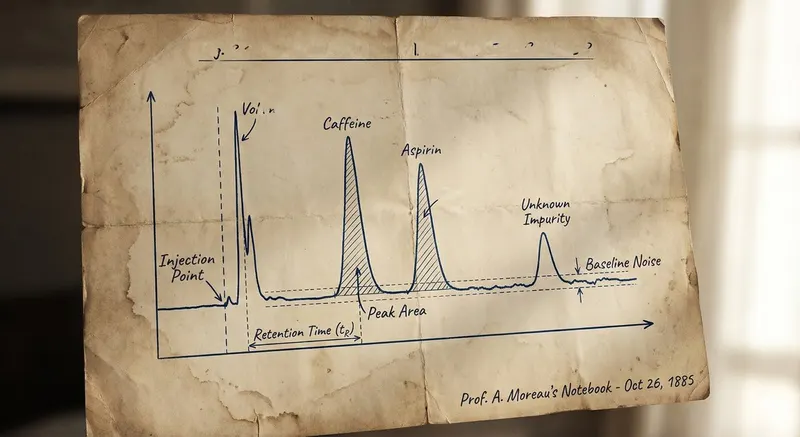
Reading a Chromatogram
Key Elements
- Retention time (tR): Position of the main peak, characteristic of the compound
- Peak area: Proportional to the amount of compound
- Width at half-height: Indicator of separation quality
- Secondary peaks: Impurities or degradation products
Purity Calculation
Purity (%) = (Main peak area / Total area) × 100
A quality research peptide typically shows purity ≥ 98%.
Standard Parameters
| Parameter | Typical Value | Comment |
|---|---|---|
| Column | C18, 5μm, 250×4.6mm | Standard reversed phase |
| Flow rate | 1.0 mL/min | Resolution/time compromise |
| Detection | UV 220nm | Peptide bond absorption |
| Gradient | Acetonitrile/Water + TFA | Progressive elution |
Results Interpretation
Main Peak
A symmetrical, narrow peak indicates a pure and stable compound. An asymmetric peak (tailing) may indicate degradation or column interaction.
Secondary Peaks
- Before main peak: Often more polar impurities or fragments
- After main peak: May be isomers or oxidized forms
Acceptance Criteria
- Purity ≥ 98% for standard research
- Purity ≥ 99% for sensitive studies
- No peak > 1% (excluding main peak)
- Retention time consistent with reference (±5%)
HPLC Limitations
HPLC only detects compounds absorbing at the wavelength used. For complete characterization, it is often coupled with mass spectrometry (LC-MS).