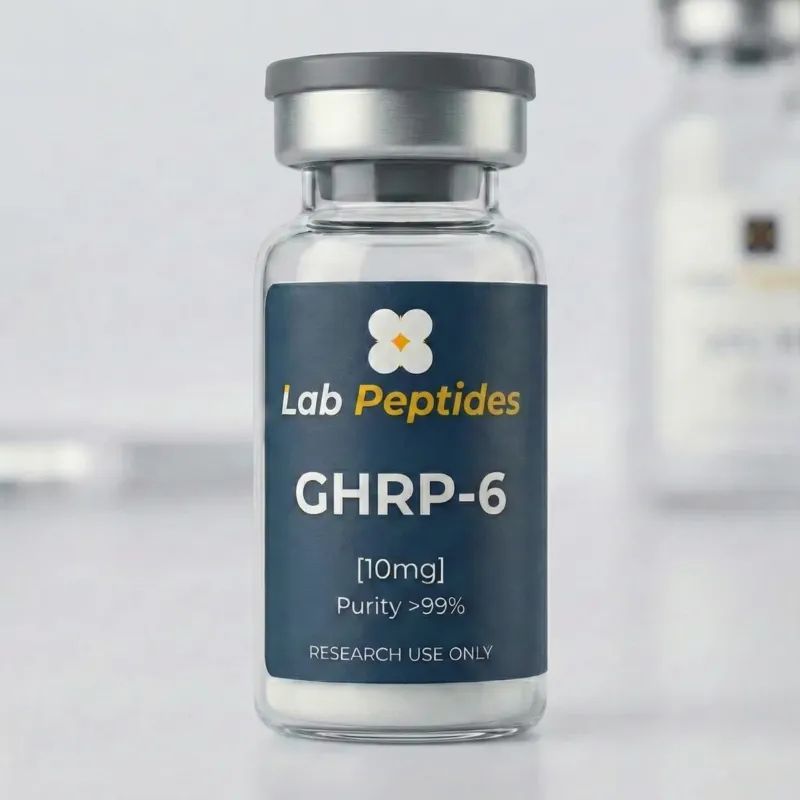
GHRP-6 10mg Muscle Growth
First-generation GHRP hexapeptide. The founding molecule of the ghrelin-mimetic secretagogue class.
The historic GH trigger. First-generation secretagogue that produces massive endogenous GH spikes. Bonus: appetite stimulation for bulking phases. 30+ years of clinical track record. The reference for clean bulking.
- In stock in France
-10 % for life on each cyclePause, skip or cancel in 1 clickNo commitment, no hidden fees
Your complete kit
- 10mg vialIncluded
- Bacteriostatic waterAdd
- 1 ml syringesAdd
The vial alone cannot be used as is. One sealed vial of GHRP-6 10mg, lyophilised, without individual labelling.
Don't forget the essentials

Product information
GHRP-6 10mg is the historical founding peptide of the Growth Hormone Releasing Peptides class. This synthetic hexapeptide His-D-Trp-Ala-Trp-D-Phe-Lys-NH2 of 872.4 Da was developed in the early 1980s by Cyril Y. Bowers' team at Tulane University (New Orleans), paving the way for the entire family of secretagogues that followed: GHRP-2, Hexarelin, Ipamorelin, synthetic ghrelin, then MK-677.
Conceptually derived from modified fragments of met-enkephalin, GHRP-6 remains the most historically studied GHRP with more than 400 publications referenced since 1984. Beyond its main action on growth hormone secretion, GHRP-6 is distinguished from other GHRPs by a particularly marked orexigenic effect, a direct consequence of its action on the ghrelin receptor at the hypothalamic level (arcuate nucleus, NPY/AgRP pathway).
Atlas Lab formulates GHRP-6 10mg as high-purity lyophilizate (≥98% HPLC) for research applications exclusively. Strict RUO — not intended for human, veterinary, diagnostic or therapeutic use. The richness of the literature on this molecule makes it a reference experimental tool for studies on the somatotropic axis, appetite regulation, and ghrelin-dependent pathways.
01Mechanism of action
GHRP-6 acts primarily as an agonist of the GHS-R1a receptor (Growth Hormone Secretagogue Receptor type 1a), identified as the endogenous ghrelin receptor in 1999 by Kojima and Kangawa. This Gq11-coupled receptor is expressed in the anterior pituitary (somatotroph cells), hypothalamus (arcuate nucleus, paraventricular nucleus, ventromedial nucleus), as well as in certain peripheral tissues including stomach, pancreas, heart and testes.
GHS-R1a activation by GHRP-6 triggers a phospholipase C-IP3-DAG-calcium cascade that causes exocytosis of GH-containing granules in somatotroph cells. In parallel, hypothalamic stimulation increases endogenous GHRH release by GHRH neurons of the arcuate nucleus and inhibits somatostatin by action on periventricular somatostatinergic neurons. This dual mechanism (direct pituitary action and amplification via GHRH/somatostatin) explains the synergy observed with GHRH analogs such as CJC-1295 DAC, Mod GRF 1-29, Sermorelin or Tesamorelin.
The characteristic orexigenic effect of GHRP-6 results from activation of NPY (neuropeptide Y) and AgRP (agouti-related peptide) neurons of the arcuate nucleus, the canonical pathway of appetite stimulation by ghrelin. This property clearly distinguishes GHRP-6 from other members of the class, Ipamorelin being quasi-inert on appetite and Hexarelin having a more modest and inconsistent effect. Animal and human studies have documented a significant increase in voluntary caloric intake in the hours following administration.
The hexapeptide structure presents D-Trp at position 2 and D-Phe at position 5, non-natural configurations that partially protect against peptidase degradation. The plasma half-life nevertheless remains short, on the order of 15 to 20 minutes, significantly inferior to that of Hexarelin (55 min) which benefits from additional D-methylation at position 2. Tmax after subcutaneous injection is around 5-15 minutes, with a GH peak reached at 15-45 minutes depending on subjects and doses.
GHRP-6 modestly stimulates cortisol, prolactin and ACTH secretion via collateral activation of hypothalamic pathways. This elevation remains inferior to that observed with GHRP-2 but superior to that of Ipamorelin (which is quasi nil). Arvat 1997 and Penalva 2001 studies quantified these rises at approximately 20-40% above basal values, without clinical significance in healthy subjects but to be considered in experimental protocols sensitive to cortisol.
Similar peptides
In the GHRP family, GHRP-6 occupies the position of historical pioneer, first member synthesized and most studied with 400+ referenced publications. Its comparison to other secretagogues of the class is essential to inform experimental choices according to the action profile sought.
Versus Hexarelin, GHRP-6 presents a potency 2-3 times inferior on the GH response at equivalent dose, as well as a shorter plasma half-life (15-20 min vs 55 min). However, GHRP-6 retains a major specific advantage: its marked orexigenic effect via activation of the ghrelin/NPY/AgRP pathway, useful in appetite research models and in experimental protocols aiming at mass gain. GHRP-6 also tolerates longer chronic cycles (6-12 weeks) than Hexarelin (4-6 weeks) due to less rapid receptor desensitization.
Versus GHRP-2 (pralmorelin), GHRP-6 offers slightly inferior potency on the GH response but a clearly superior orexigenic effect. GHRP-2 instead induces a more marked rise in cortisol and prolactin than GHRP-6, which may constitute a disadvantage in certain protocols sensitive to these parameters. GHRP-6 remains preferred when appetite stimulation is desired; GHRP-2 when GH potency prevails without as much orexigenic effect.
Versus Ipamorelin, the contrast is marked. Ipamorelin is the most selective pentapeptide of the class, with GH stimulation comparable to GHRP-6 but without elevation of cortisol, prolactin or ACTH, and without significant orexigenic effect. GHRP-6, less selective, induces a slight rise in cortisol (approximately 20% basal) and a marked orexigenic effect. The choice between the two molecules depends on the action profile sought: for pure chronic protocols on the GH axis, Ipamorelin prevails; for studying simultaneously appetite and GH or for protocols requiring an orexigenic effect, GHRP-6 remains the reference.
Versus MK-677 (Ibutamoren), non-peptide orally active secretagogue with a half-life of 24 hours, GHRP-6 offers a more physiological pulsatile action but requires multiple daily injections. MK-677 maintains chronic elevation of GH/IGF-1 with an also documented orexigenic effect, but can induce water retention, insomnia (paradoxical in some), insulin resistance and prolonged hyperphagia. GHRP-6 used in short cycles presents a more controlled metabolic profile.
Versus GHRH analogs (CJC-1295 DAC, Mod GRF 1-29, Sermorelin, Tesamorelin), GHRP-6 acts through a complementary mechanism via GHS-R1a rather than GHRH-R. The combination of the two classes produces synergy documented by Ghigo 1996, with a GH peak more than 10 times superior to GHRH alone. This synergy is exploited in research protocols combining GHRP-6 100 mcg plus Mod GRF 1-29 100 mcg in simultaneous injection 2-3 times per day. The combination with CJC-1295 DAC (6-8 day half-life) offers a simplified approach (1-2 mg CJC-1295 DAC per week plus GHRP-6 3x/day).
The orexigenic effect of GHRP-6 constitutes its main differentiating element in experimental choice. For a body recomposition protocol (fat loss plus lean mass gain), Ipamorelin or Hexarelin are preferred. For a mass gain protocol with appetite stimulation, or for studying hypothalamic pathways of hunger regulation via ghrelin, GHRP-6 remains essential.