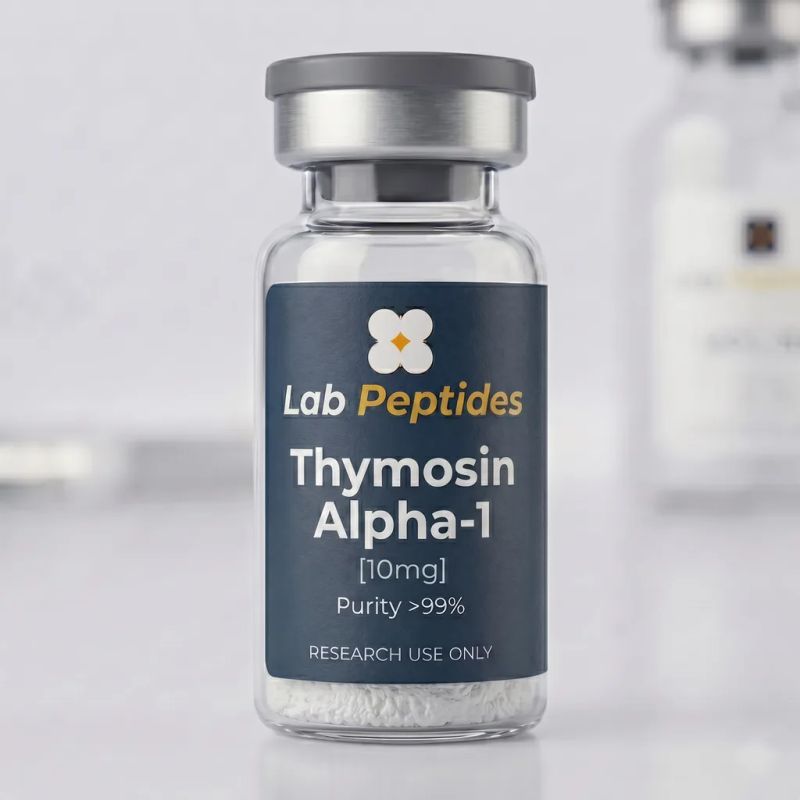
Thymosin Alpha-1 10mg Immunity & Health
Bouclier immunitaire, utilisé dans 30+ pays. Format renforcé.
Thymosin Alpha-1 10mg — the immune shield, reinforced format. T-lymphocyte maturation, boosted innate defenses, complete immunomodulation. 70+ clinical trials, used in 30+ countries. The must-have for high-risk seasons. HPLC ≥ 98 %. EU stock, ships the next day.
- In stock in France
-10 % for life on each cyclePause, skip or cancel in 1 clickNo commitment, no hidden fees
Your complete kit
- 10mg vialIncluded
- Bacteriostatic waterAdd
- 1 ml syringesAdd
The vial alone cannot be used as is. One sealed vial of Thymosin Alpha-1 10mg, lyophilised, without individual labelling.
Don't forget the essentials
Frequently bought together



Product information
Thymosin Alpha-1 10mg (Talpha1, thymalfasin) is an N-acetylated 28 amino acid polypeptide, the bioactive fragment of thymosin fraction 5 secreted by the thymus. Identified in the 1970s by Allan Goldstein's team, it is today the most studied thymic peptide in the immunology literature, to the point of having yielded a drug marketed as Zadaxin in over thirty countries as a reference immunomodulator.
This 10mg format is the reinforced format: it doubles the material of the standard 5mg vial, sized for demanding immunological research protocols or extended fractionated-dose explorations, without multiplying reconstitutions. A single HPLC >98% controlled batch to run a complete series of experiments with homogeneous material.
Unlike growth or tissue-repair peptides, Thymosin Alpha-1 targets a single system with remarkable precision: cellular immunity. It is the reference tool for studying T lymphocyte maturation, Th1/Th2 balance and dendritic cell response, making it a must-have in immunomodulation protocols and seasonal immune-stress models.
01Mechanism of action
Thymosin Alpha-1's mechanism of action relies on a coordinated activation of innate and adaptive immunity, which sets it apart from single-target immunostimulants.
Toll-like receptor activation. Talpha1 activates the TLR-2 and TLR-9 receptors on the surface of dendritic cells and monocytes. This binding triggers the MyD88 pathway then NF-kappaB translocation, leading to dendritic cell maturation and enhanced antigen presentation. It is the initiating event of the immunomodulatory cascade.
Th1 orientation and T lymphocyte maturation. Talpha1 promotes the differentiation of helper T lymphocytes toward the Th1 profile, with increased production of IL-2 and interferon gamma. It stimulates T lymphocyte maturation within the thymus, increases functional CD4+ and CD8+ populations and restores a favorable Th1/Th2 ratio in documented immunosuppression contexts.
NK activity and rebalancing. Beyond T lymphocytes, Talpha1 increases the cytotoxic activity of NK (natural killer) cells and modulates the production of pro- and anti-inflammatory cytokines, tending to rebalance a dysregulated immune system rather than over-stimulate it. This bidirectional modulation property is the peptide's pharmacological signature and explains its adjuvant use in varied clinical contexts.
Similar peptides
Thymosin Alpha-1 10mg vs 5mg. Same molecule, same purity. The 5mg suffices for a short test. The 10mg is the reinforced format for long or fractionated-dose protocols: a single batch covers a complete series, ensuring material homogeneity and a better cost per milligram. For sustained immunological research, the 10mg is the obvious choice.
Thymosin Alpha-1 vs Thymosin Beta-4 (TB-500). Frequent confusion, very different molecules. Talpha1 is a 28 amino acid thymic peptide targeting immunity (T lymphocyte maturation, dendritic cells). Beta-4 / TB-500 is a 43 amino acid peptide targeting cell migration and tissue repair (actin, angiogenesis). Opposite biological targets despite the shared name.
Thymosin Alpha-1 vs other peptide immunomodulators. Compared with single-action immunostimulants, Talpha1 stands out for its bidirectional modulation: it rebalances rather than over-activates, a rare and documented property that explains its extensive clinical corpus.
Thymosin Alpha-1 vs LL-37 / KPV. LL-37 and KPV target antimicrobial immunity and local inflammation more; Talpha1 acts upstream on T lymphocyte maturation and orientation. Complementary in a global immune approach.