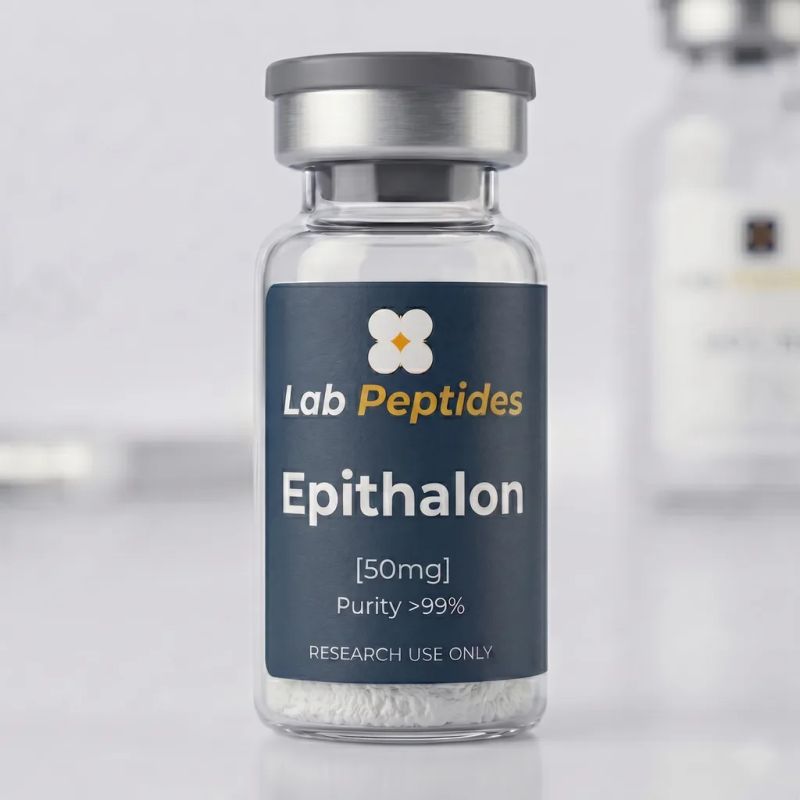
Epithalon 50mg Antiedad
Formato cura larga. El tetrámero de la longevidad.
Epithalon 50mg — formato cura larga del tetrámero de longevidad más documentado. Modulador de la telomerasa y del eje pineal: ciclos celulares, sueño profundo, ritmo circadiano. 5x de materia para los protocolos extendidos. HPLC ≥ 98 %.
- Stock en Francia
-10 % de por vida en cada cicloPause, salte o cancele en 1 clicSin compromiso, sin gastos ocultos
Tu kit completo
- Vial 50mgIncluido
- Agua bacteriostáticaAñadir
- Jeringas de 1 mlAñadir
El vial por sí solo no puede usarse tal cual. Un vial sellado de Epithalon 50mg, liofilizado, sin etiquetado individual.
No olvide lo imprescindible
Se compran juntos a menudo



Información del producto
Epithalon 50mg (Epitalon, Epithalone, AEDG) is a synthetic tetrapeptide with the sequence Ala-Glu-Asp-Gly, the short, stabilized version of Epithalamin, the pineal gland extract isolated in the 1980s by Vladimir Khavinson's Russian school of gerontology. With a molecular weight of approximately 390 Da, this tetramer is today the most documented anti-aging peptide in the bioregulation literature, studied continuously for over three decades at the St. Petersburg Institute of Bioregulation and Gerontology.
This 50mg format is not just a vial: it is the long-cure format. Most Epithalon research protocols rely on short but repeated cycles (10 to 20 days, several times a year). Concentrating 50mg of material in a single HPLC >98% vial covers a full research cycle without multiplying reconstitutions, handling steps and contamination risks. It is the choice of serious, longitudinal protocols where batch consistency matters most.
Its scientific appeal rests on a target unique among peptides: telomerase, the enzyme that rebuilds chromosome ends. On this target, Epithalon has generated in vitro and animal data that few research molecules can claim, placing it at the heart of research on cellular senescence and the biological clock.
01Mecanismo de acción
Epithalon's mechanism of action is organized around three complementary axes that explain its reference status in aging research.
Telomerase activation. With each division, somatic cells lose a fraction of their telomeres, the protective caps at chromosome ends; once they reach the Hayflick limit, they enter senescence. Khavinson's work (2003) showed that Epithalon induces expression of the catalytic subunit of telomerase (hTERT) in human somatic fibroblasts, with measurable telomere elongation and resumption of divisions beyond the expected limit. This founding observation made the tetramer a major study molecule.
Restoration of the pineal axis and melatonin. Epithalon derives from the pineal gland and acts upon it. Russian studies document a normalization of the circadian melatonin rhythm in aged subjects, whose nocturnal secretion collapses with age. This restoration of the nocturnal peak underlies observations on deep sleep and circadian synchronization.
Modulation of gene expression. Khavinson's model proposes that short peptides penetrate the nucleus and interact directly with DNA promoter sequences, modulating the expression of genes linked to the cell cycle, repair and antioxidant defense. This concept of peptide epigenetic regulation remains central in the Russian bioregulation literature.
Péptidos similares
Epithalon 50mg vs 10mg. Same molecule, same purity; the difference is strategic. The 10mg suits a one-off test or a mini-cycle. The 50mg is the format for longitudinal protocols: a single batch for a full cycle, hence zero inter-vial variability over the experiment, and a markedly better cost per milligram. For any serious senescence research, the 50mg is the rational choice.
Epithalon vs GHK-Cu. Two anti-aging references with distinct targets: Epithalon acts on telomerase and the pineal axis (biological clock, replicative senescence); GHK-Cu acts on the extracellular matrix and over 4000 tissue regeneration genes (skin, collagen). Complementary rather than competing.
Epithalon vs NAD+. NAD+ targets cellular energy metabolism and sirtuins; Epithalon targets telomere length and circadian rhythm. Two different levers of aging biology.
Epithalon vs non-peptide telomerase activators (TA-65 type). Epithalon is a short synthetic peptide with a defined sequence, verifiable by HPLC, whereas astragalus plant extracts show significant compositional variability. Molecular precision is the tetramer's argument.