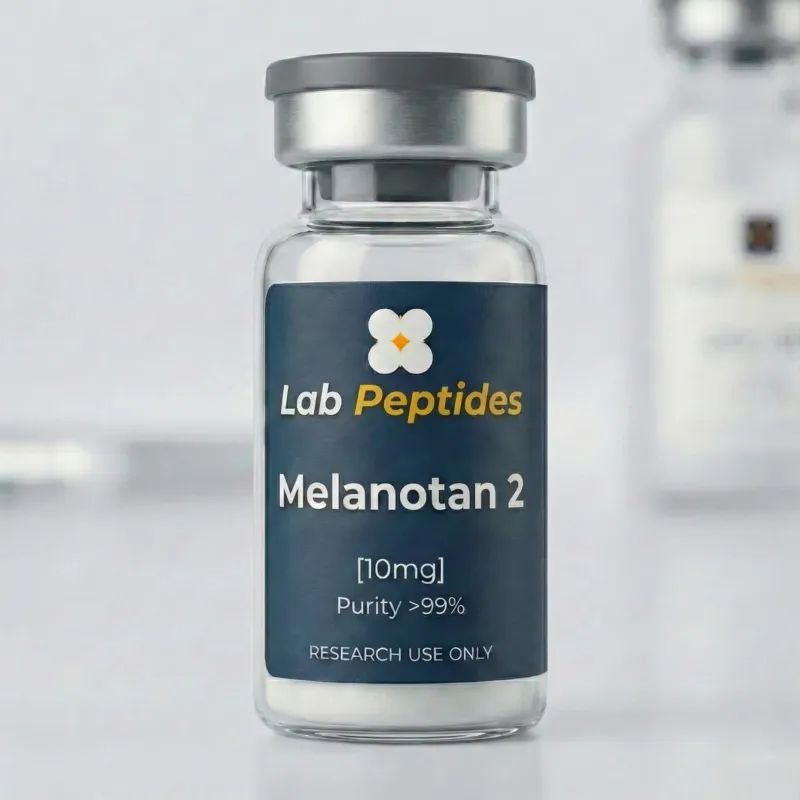
Melanotan 2 10mg Bienestar
Bronceado sin UV, top 3 en ventas.
El péptido de bronceado del top 3 de nuestros péptidos más vendidos. Activación de los receptores de melanocortina MC1R — bronceado sin UV, duradero y homogéneo. Extra libido (acción MC4R) observado desde los primeros ensayos clínicos. Sol sin sol, libido de regalo.
- Certificado de análisis del lote
- Stock en Francia
-10 % de por vida en cada cicloPause, salte o cancele en 1 clicSin compromiso, sin gastos ocultos
Tu kit completo
- Vial 10mgIncluido
- Agua bacteriostáticaAñadir
- Jeringas de 1 mlAñadir
El vial por sí solo no puede usarse tal cual. Un vial sellado de Melanotan 2 10mg, liofilizado, sin etiquetado individual.
No olvide lo imprescindible
Se compran juntos a menudo



Información del producto
Melanotan-2 10mg (MT-II, MT-2) is a non-selective synthetic analog of alpha-melanocyte stimulating hormone (alpha-MSH) with the sequence Ac-Nle-cyclic[Asp-His-D-Phenylalanine-Arg-Trp-Lys]-NH2. Developed during the 1980s by Victor Hruby and Mac Hadley's teams at the University of Arizona, this 1024 Da cyclic heptapeptide was initially designed to prevent skin cancer by stimulating protective melanin synthesis without requiring prolonged solar exposure. Cyclization between Asp and Lys residues and substitution of natural phenylalanine by its D enantiomer dramatically increase metabolic stability and potency versus endogenous alpha-MSH, with a plasma half-life of approximately 33 hours post-subcutaneous administration.
Unlike PT-141 (Bremelanotide, Vyleesi FDA 2019), derived from the same melanocortin chemistry but deliberately MC3R/MC4R-central selective to avoid pigmentation, Melanotan-2 is deliberately non-selective and activates the full melanocortin receptor set MC1R, MC3R, MC4R, and MC5R. This unique polypharmacology generates an action profile combining three distinct dimensions: active cutaneous pigmentation via MC1R on epidermal melanocytes, central sexual stimulation via hypothalamic MC3R/MC4R (spontaneous erections in men, libidinal stimulation in both sexes), and appetite modulation via MC4R with transient anorexigenic effect.
MT-2 is not approved as a drug in the United States or Europe; its first-generation cousin Melanotan-1 (Afamelanotide, Clinuvel's Scenesse) has conversely obtained FDA approval in 2019 for treatment of erythropoietic protoporphyria (EPP), validating the MC1R therapeutic activation proof of concept. For MT-2, legal status in Europe is that of a research-use-only (RUO) compound, its over-the-counter sale specifically prohibited in the United Kingdom by MHRA since 2008 and monitored in several EU countries.
The Atlas Lab Melanotan-2 10mg vial ships lyophilized, HPLC specification of at least 98% purity; the certificate of analysis is published on this page. In exploratory research, MT-2 occupies a unique position in the melanocortin space: that of a universal analog enabling simultaneous study of pigmentation, sexual behavior, appetite, and thermoregulation axes, with sufficient potency to generate observable biological effects at low subcutaneous doses of 250 to 500 mcg.
01Mecanismo de acción
Melanotan-2 mechanism of action articulates four distinct biological pathways corresponding to the four activated melanocortin receptor subtypes, each localized in different tissues and mediating specific physiological effects.
First pathway, cutaneous pigmentation via MC1R on epidermal melanocytes. MC1R activation by MT-2 triggers an adenylate-cyclase-cAMP-PKA-CREB-MITF cascade culminating in transcriptional stimulation of the tyrosinase gene, key enzyme of melanogenesis. The result is differential switching between phaeomelanin (red/yellow pigment, weakly photoprotective) and eumelanin (brown/black pigment, strongly photoprotective), with progressive predominance of eumelanin in melanosomes transferred to keratinocytes. Induced photoprotection represents roughly SPF 3 to 5 equivalent, insufficient to replace classical solar protection but sufficient to reduce actinic erythema and UVB-induced DNA damage. Crucially, MC1R activation by MT-2 does not eliminate the need for UV exposure: final pigmentation results from synergy between MT-2 melanocyte stimulation and UV stimulation activating melanosome maturation and transfer.
Second pathway, sexual behavior via central MC3R and MC4R. MT-2 crosses the blood-brain barrier at therapeutic doses and activates MC3R and MC4R receptors expressed in the hypothalamus (paraventricular nucleus), locus coeruleus, and sacral spinal cord. This central activation triggers oxytocin release, dopamine in mesolimbic reward circuits, and stimulates the sacral parasympathetic system responsible for male erection and female lubrication. Wessells and colleagues (1998, Urology) documented durable spontaneous erections in 80% of men receiving 0.025 mg/kg MT-2 subcutaneously, with onset 30 to 90 minutes post-injection and duration of 2 to 4 hours. Female libidinal stimulation is also documented but less quantified than in men. This central melanocortin action is exactly that exploited by FDA-approved PT-141 Bremelanotide, with the difference that MT-2 combines this effect with pigmentation.
Third pathway, appetite modulation via hypothalamic MC4R. Activation of paraventricular nucleus MC4R neurons inhibits agouti-related peptide (AgRP) orexigenic signals and stimulates proopiomelanocortin (POMC) anorexigenic signals. Users frequently report significant appetite reduction within 1 to 2 hours following injection, with moderate weight loss documented over 2-to-4-week cycles. This anorexigenic effect is not the primary goal of MT-2 but constitutes a predictable side effect of the mechanism of action. MC4R polymorphisms being one of the most documented genetic causes of human obesity, this pathway is subject to active pharmaceutical research with molecules like Setmelanotide (Imcivree FDA 2020).
Fourth pathway, thermoregulation, inflammation, and exocrine functions via MC5R. MC5R is expressed on sweat, sebaceous, and exocrine glands, and in several immune populations. Its activation by MT-2 modulates thermoregulation, sebaceous production (sometimes associated with increased acne), and exerts anti-inflammatory action via cytokine regulation. This pathway is the least well-characterized of the melanocortin quartet but contributes to the overall MT-2 effect profile.
Péptidos similares
Melanotan-2 positioning in the melanocortin space clarifies through systematic comparison with the four main analogs sharing the same base chemistry but with distinct selectivity profiles.
Versus Melanotan-1 (Afamelanotide, Clinuvel's Scenesse, FDA 2019), MT-2 distinguishes itself by its non-selective profile and capacity to simultaneously activate central MC3R and MC4R receptors. MT-1 is a more MC1R-selective linear decapeptide and generates pure cutaneous pigmentation without MT-2 sexual effects. MT-1 is marketed as a 16 mg sustained-release subcutaneous implant for treatment of erythropoietic protoporphyria (EPP), a rare disease. MT-1 advantages: pharmaceutical approval, absence of disruptive central effects. MT-2 advantages: broadened polypharmacology, classical subcutaneous route, accessible cost, availability for exploratory research.
Versus PT-141 (Bremelanotide, Palatin Technologies' Vyleesi, FDA 2019), MT-2 presents exactly inverse polarity. PT-141 is optimized for central MC3R/MC4R selectivity and eliminates MC1R activity to completely avoid undesirable pigmentation in women with sexual dysfunction. MT-2 conversely retains MC1R activity and adds pigmentation to its sexual action profile. For the user seeking exclusively a sexual effect without pigmentation, PT-141 is the optimal choice. For the user seeking tan + sexual effect, MT-2 is the integrated tool. Both peptides share the same central MC4R hypothalamic activation mechanism with oxytocin and dopamine release.
Versus Setmelanotide (Rhythm Pharmaceuticals' Imcivree, FDA 2020), MT-2 occupies a completely different position. Setmelanotide is a selective MC4R agonist specifically approved for rare monogenic obesities (POMC, LEPR, PCSK1 deficiencies) and focuses exclusively on the hypothalamic MC4R anorexigenic pathway. MT-2 also activates this pathway but anorexigenic effect is not its primary goal and doses used in exploratory research generate modest appetite reduction rather than therapeutic action on obesity.
Versus natural alpha-MSH (endogenous hormone), MT-2 is approximately 1000-fold more potent in vitro thanks to cyclization and D-substitution, and displays a plasma half-life of 33 hours against less than 10 minutes for native alpha-MSH. This major pharmacokinetic difference explains why MT-2 is usable in spaced dosing (2-3 times per week in maintenance) whereas endogenous alpha-MSH is continuously secreted and degraded.
The verdict: Melanotan-2 combines tanning and libido in a single molecule. HPLC specification of at least 98%, certificate published on this page. Its profile is broad (nausea, mole changes, effect on desire): have your skin checked before and during the protocol.