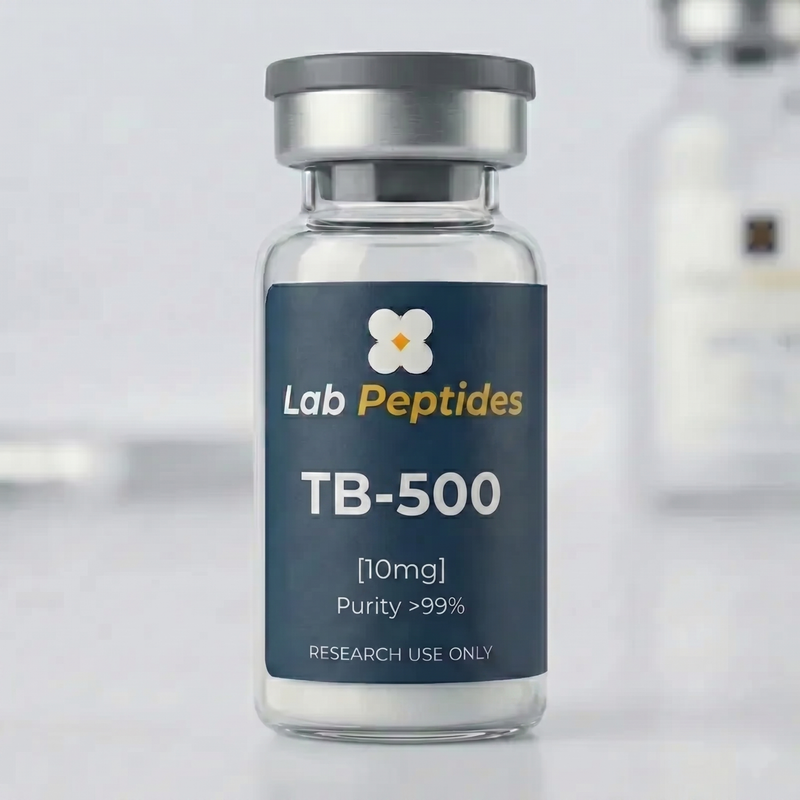
TB-500 10mg Recuperación
El compañero del BPC-157.
El compañero imprescindible del BPC-157. Fragmento de Thymosin Beta-4 — migración celular sistémica, angiogénesis, recuperación muscular profunda. Acción complementaria al BPC-157 (que actúa en local). Combo estándar de los protocolos de recuperación avanzados.
- Certificado de análisis del lote
- Stock en Francia
-10 % de por vida en cada cicloPause, salte o cancele en 1 clicSin compromiso, sin gastos ocultos
Tu kit completo
- Vial 10mgIncluido
- Agua bacteriostáticaAñadir
- Jeringas de 1 mlAñadir
El vial por sí solo no puede usarse tal cual. Un vial sellado de TB-500 10mg, liofilizado, sin etiquetado individual.
Este producto contiene TB-500. Los trabajos publicados abordan la angiogénesis, la formación de nuevos vasos sanguíneos. Ningún ensayo clínico humano aleatorizado ha caracterizado las contraindicaciones.
Las alertas teóricas descritas en los trabajos preclínicos afectan a los antecedentes de cáncer, en particular tumores sólidos muy vascularizados, al embarazo y la lactancia, y a las retinopatías proliferativas.
No olvide lo imprescindible
Se compran juntos a menudo



Información del producto
Our TB-500 10 mg vial is the reference format for extended research protocols in experimental regenerative medicine, preclinical cardiac repair, and tissue healing. With 10 mg of lyophilized peptide per vial at HPLC purity ≥98 %, this format suits extended loading phases (2.5 mg/week x 4-6 weeks) and combined protocols with BPC-157. The certificate of analysis is published on this page, viewable before you order. TB-500 10 mg is intended for research laboratories, experimental sports medicine researchers, and clinics engaged in documented preclinical protocols. Why choose 10 mg? Covers an entire loading phase (4 weeks at 2.5 mg/week), optimized volume/price ratio, final concentration adjustable (5 mg/ml with 2 ml, or 2.5 mg/ml with 4 ml for fractionated doses). The flagship for serious regenerative research.
01Mecanismo de acción
TB-500 (Thymosin Beta-4 peptide, or active fragment of Tbeta-4) is a synthetic peptide derived from Thymosin Beta-4, a 44-amino-acid protein initially identified in the thymus and widely distributed across mammalian tissues. Most research suppliers offer either the full 1-44 sequence (Tbeta-4) or the active 17-23 fragment (LKKTETQ), the latter considered the key functional site responsible for several documented biological effects.
The established primary mechanism of TB-500 is G-actin (monomeric actin) sequestration via a specific binding site, which regulates actin-filamentary dynamics and cellular motility. This fundamental action influences the migration of fibroblasts, corneal keratocytes, endothelial progenitors, and epicardial cardiac progenitors in studied models.
Published work has documented several convergent secondary pathways. First, mobilization of endothelial progenitor cells (EPCs) from bone marrow to injury sites, observed in cardiac and vascular repair models. Second, upregulation of VEGF (Vascular Endothelial Growth Factor) and stimulation of local angiogenesis, critical for post-ischemic tissue revascularization. Finally, anti-inflammatory modulation via the NF-kappaB axis and documented reduction of pro-inflammatory markers (TNF-alpha, IL-1beta) in various murine models.
At the tissue level, the preclinical literature has reported accelerated healing in multiple systems: cornea, skin, Achilles tendon, ligament, post-infarction cardiac muscle, colic mucosa. TB-500 displays plasma stability superior to classical regenerative peptides, with documented systemic diffusion making it a subject of particular interest for repair models distant from the injection site.
As with any research peptide, these data come exclusively from preclinical models (rodent, porcine, in vitro) and limited studies. No marketing authorization exists for human therapeutic use: TB-500 remains strictly a peptide intended for exploratory research.
TB-500 is a synthetic 7-amino-acid fragment (Leu-Lys-Lys-Thr-Glu-Thr-Gln, LKKTETQ, 889.0 Da) corresponding to the active sequence of thymosin β-4 (Tβ4, 43 aa, 4960 Da), a ubiquitously expressed endogenous protein involved in the cytoskeleton. The canonical molecular mechanism of Tβ4 is monomeric G-actin sequestration via its β-thymosin domain (17-35), preventing premature polymerisation into F-actin filaments and freeing actin for rapid cytoskeletal rearrangements during cell migration. The LKKTETQ fragment (TB-500) partially retains this G-actin binding activity. Tβ4 also exerts anti-fibrotic effects via its N-terminal acetylated metabolite Ac-SDKP (N-acetyl-seryl-aspartyl-lysyl-proline, cleaved by prolyl-endopeptidase), which inhibits activated fibroblast proliferation and type I collagen accumulation. Documented signalling pathways include Integrin-Linked Kinase (ILK) activation, NF-κB downregulation, and modulation of several pro-regenerative microRNAs (miR-146a, miR-124).
Péptidos similares
TB-500 occupies a central position in the regenerative research peptide class, with a distinctive profile that differentiates it from other candidates in the same category. Compared to BPC-157 (protective pentadecapeptide), TB-500 acts via G-actin sequestration and systemic mobilization of endothelial progenitors, whereas BPC-157 favors an NO-dependent pathway and more local VEGFR2 modulation. Both peptides are often associated in research protocols to explore the synergy of their complementary mechanisms, particularly in tendon and cardiac repair models.
Compared to classical growth factors such as GH (Growth Hormone) or IGF-1, TB-500 presents a significantly more targeted action profile on cell migration and matrix remodeling, without the systemic endocrine anabolic effects characteristic of GH/IGF-1. This specificity makes it a preferred candidate for protocols seeking to stimulate tissue regeneration without disrupting the somatotropic axis.
Compared to full-sequence Tbeta-4 (44 amino acids), the TB-500 fragment (LKKTETQ, residues 17-23) offers more economical synthesis, superior stability, and similar pharmacokinetics in most studied models. Some publications have however suggested that the full sequence might present a slightly different immunomodulatory profile, which remains an open subject of investigation.
Compared to GHK-Cu (copper peptide) or IGF-1 LR3, TB-500 stands out for its systemic mobilization of EPC progenitors from bone marrow, a characteristic relatively unique in this class. In our shop, TB-500 is the second most ordered recovery peptide, just behind BPC-157. Commercialization for human therapeutic use remains prohibited in France, Europe, and the United States.
TB-500 occupies a complementary position to BPC-157 in research healing/regeneration protocols. Where BPC-157 acts primarily via NO/VEGF/Egr-1 on digestive, tendinous and vascular tissues, TB-500 targets actin-cytoskeleton dynamics and the Ac-SDKP anti-fibrotic axis, with documented predominance on cardiac muscle, cornea and diabetic skin. Compared to full-length Tβ4 (4960 Da), TB-500 offers the pharmacological advantage of lower molecular mass (889 Da, better tissue diffusion) but loses the complete anti-apoptotic and angiogenic properties of the native protein. Compared to IGF-1 LR3 (long R3 IGF-1, 9111 Da), TB-500 does not directly stimulate cell proliferation but favours migration and tissue reorganisation. Compared to collagen precursors (bioactive hydrolysed collagen peptides, massive doses required), TB-500 acts at preclinical micromolar doses with a targeted molecular mechanism. The TB-500 + BPC-157 synergy is proposed as a "regenerative stack" in grey literature, validated by several rodent preclinical studies showing additive effects on multi-compartmental tendon injury models.