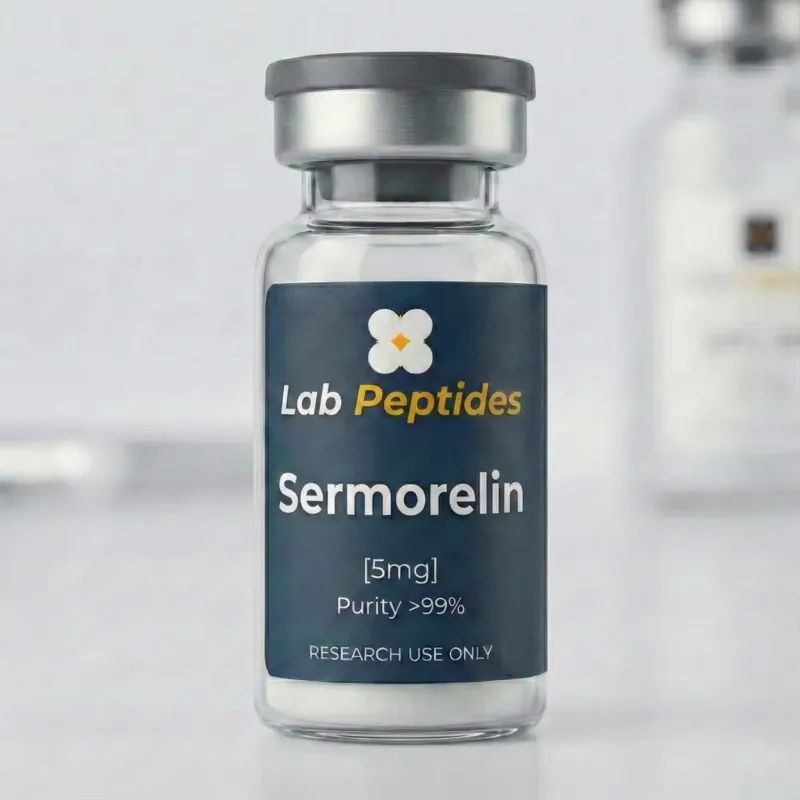
Sermorelin 5mg Antiedad
Reactive su GH natural.
El análogo GHRH de referencia. Sermorelin reactiva su producción natural de hormona de crecimiento — una estimulación limpia y fisiológica. Preserva los bucles de retroalimentación, sin riesgo de inhibición del eje. La elección premium para la longevidad hormonal.
- Stock en Francia
-10 % de por vida en cada cicloPause, salte o cancele en 1 clicSin compromiso, sin gastos ocultos
Tu kit completo
- Vial 5mgIncluido
- Agua bacteriostáticaAñadir
- Jeringas de 1 mlAñadir
El vial por sí solo no puede usarse tal cual. Un vial sellado de Sermorelin 5mg, liofilizado, sin etiquetado individual.
No olvide lo imprescindible

Información del producto
Our Sermorelin 5 mg vial is the historical reference of the GHRH analog class for somatotropic axis research. Initially developed in the 1980s under the name Geref by Serono, Sermorelin corresponds to the 1-29 fragment of human GHRH (truncated native sequence, amino acids 1 to 29 of 44), considered the minimal active site for GHRH-R receptor binding. With 5 mg of lyophilized peptide per vial at HPLC purity ≥98 %, this format covers approximately 15-25 days of protocol at the typical 200-500 mcg/day dose. Sermorelin presents a short pharmacokinetic profile (10-15 minute half-life) requiring daily administrations, unlike CJC-1295 DAC (6-8 day half-life). This rapid kinetics allows quick return to baseline and mimics endogenous pulsatile physiology. Sermorelin remains the historical reference for research protocols seeking to avoid chronic GHRH-R axis stimulation.
01Mecanismo de acción
Sermorelin is a synthetic 29-amino-acid peptide corresponding to the first 29 N-terminal residues of native human GHRH (the complete molecule has 44 amino acids). Molecular weight 3358 Da. Truncation at position 29 fully preserves the active site necessary for GHRH-R receptor activation, while simplifying chemical synthesis and offering sufficient stability for clinical use.
At the molecular level, Sermorelin activates the GHRH-R receptor expressed on the surface of somatotropic cells of the anterior pituitary. Receptor binding triggers a Gs-cAMP-PKA signaling cascade leading to GH synthesis and its pulsatile release from storage granules. Sermorelin faithfully reproduces the action of endogenous native GHRH, preserving the physiological pulsatility of GH secretion — a critical element since pulses are essential to downstream tissue response (IGF-1, lipolysis, protein synthesis).
Pharmacokinetically, Sermorelin presents a short plasma half-life of 10-15 minutes after subcutaneous administration. The GH plasma peak is observed at 30-60 minutes, with return to baseline values in 2-3 hours. This rapid kinetics mimics endogenous physiology: native GHRH is itself secreted pulsatilely with a very short plasma half-life.
GHRH-R receptor activation by Sermorelin does NOT produce significant increases in prolactin, cortisol, or ACTH. It depends on physiological pulsatile stimulation rather than continuous exposure, thus avoiding receptor desensitization. Sermorelin thus retains its efficacy over extended protocols, unlike certain GHRH analogs with overly extended kinetics.
Unlike GHRPs (Ipamorelin, GHRP-6) which act via the GHS-R1a receptor (ghrelin receptor), Sermorelin remains strictly in the GHRH-R pathway. A synergy is documented in combination with selective GHRPs (Ipamorelin), although the CJC-1295 DAC + Ipamorelin combination is more studied in recent literature. As with any research peptide, these data come from preclinical and historical clinical studies: Sermorelin was marketed under the name Geref for the treatment of GH deficiency in children between 1997 and 2008, then withdrawn from the American market for commercial reasons.
Péptidos similares
Sermorelin occupies a historical position in the GHRH analog class, being the first to obtain FDA approval (1997, commercial name Geref). Its short kinetic profile faithfully reproduces the endogenous physiology of native GHRH.
Compared to CJC-1295 DAC (tetra-substituted GHRH analog with Drug Affinity Complex, 6-8 day half-life), Sermorelin presents a radically different kinetics (10-15 minute half-life). Sermorelin mimics physiological pulsatility while CJC-1295 DAC maintains chronic GHRH-R receptor sensitization. For protocols seeking to avoid prolonged stimulation, Sermorelin remains relevant. To maximize duration of action and reduce injection frequency, CJC-1295 DAC is preferred.
Compared to CJC-1295 without DAC (Mod GRF 1-29, tetra-substituted but without albumin conjugation, 30-minute half-life), Sermorelin is the unmodified native sequence. Effects are comparable but Mod GRF 1-29 plasma stability is slightly superior thanks to D-Ala2/Gln8/Ala15/Leu27 substitutions protecting against DPP-IV.
Compared to Tesamorelin (GHRH analog marketed under the name Egrifta for HIV lipodystrophy, trans-3-hexenoic acid linked to position 1), Tesamorelin presents an intermediate half-life of 26-38 minutes and retains increased plasma stability. Tesamorelin obtained maintained FDA approval and is produced under strict therapeutic formulation.
Compared to GHRPs (Ipamorelin, GHRP-6, Hexarelin), Sermorelin acts on a completely different pathway: GHRH-R versus GHS-R1a/ghrelin. The two pathways are independent and synergistic. The Sermorelin + Ipamorelin combination is a valid research option although less popular than CJC-1295 DAC + Ipamorelin in modern literature.
Compared to exogenous recombinant GH (somatropin), Sermorelin preserves the physiological pulsatility of endogenous secretion, which maintains better tissue response and avoids GH receptor desensitization according to literature.
On the research peptide market, Sermorelin maintains stable demand for protocols seeking short and physiological kinetics, even though it is supplanted in popularity by CJC-1295 DAC. Its commercialization for human therapeutic use remains limited to American compounding pharmacies outside historical pediatric indications — strict research use in Europe.